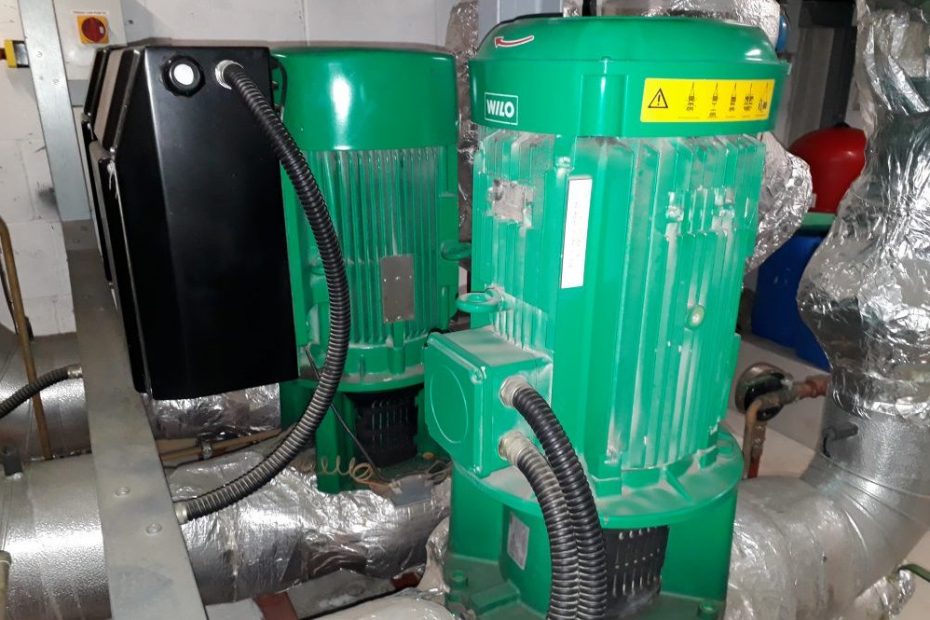
These two chilled water pumps are the same power as all 1500 lights in their building. Like lights, pumps can be ‘dimmed’. On cooler days the amount saved is equivalent to turning off 1400 lights, leaving only 100 on.
These pumps can transfer 600kW of cooling power and they are designed to handle the hottest day in summer.
In Britain…there are not many hot days in Summer!
Turning pumps down in milder weather has as surprisingly large effect on energy consumption…for only a small effect on system capacity. Halving the pump speed saves 87.5% of energy.
We have programmed pumps, blower, compressors (anything that makes fluid flow) to adjust to the demand required of it. Over the course of a year, in British weather, we estimate saving over 80% of pump cost for no loss of comfort.
To understand this it is useful to go into the maths…
The maths
Pumps flow is defined by the pump affinity laws…which in turn have their roots in the Bernoulli and Darcy-Weisbach equations describing fluid flow and frictional losses in fluids.
Pump affinity laws
Flow ∝ Speed
Pressure ∝ Speed ²
Power ∝ Speed ³
Cooling Power
The cooling power transferred is proportional to flow
Cooling Power = cpF dT
The power required to do this against frictional forces in the pipes increases with the cube of speed…
Flow is expensive…
…so a doubling of flow rate increases power required by 2³ = 8
This is why small reductions in flow can make large savings.
For more information please see Darcy Weisbach equations describing frictional forces in pipes.
Addendum
The obsevant, will notice that in the picture above, one pump has an inverter and one does not. The inverter allows speed adjustment on the secondary circuit, whereas the primary circuit has a fixed flow specified by the chiller.
Secondary pump
Before our programming the inverter on the secondary was programmed to maintain a relatively high pressure. Flow would adjust by 1-2% as the FCU valves opened on the secondary circuit. Our programming modified the flow rate by up to 60% based on real cooling demand (see previous notes on demand based control), allowing the power consumption to range between 6.4% and 100%. Based on demand the pump less than 20% of its capacity even in summer.
Primary pump
This pump does not have an inverter so it must be either on or off interlocked with the chiller operation. A real cooling demand will only request as much power as is needed, so the chiller and primary pumps are only on some of the time. Stored thermal mass is maximised in order to minimise chiller starts. Installation of inverters on the primary (in order to halve the flow through one, not two chillers) and installation of variable frequency drives on the chiller are ways of maintaining the efficiency whilst also allowing softer pump starts to increase lifespan.